Smile Everyday Quote Lettering SVG
A Warm, Hand-Drawn Vibe—But Does It Stitch Cleanly?
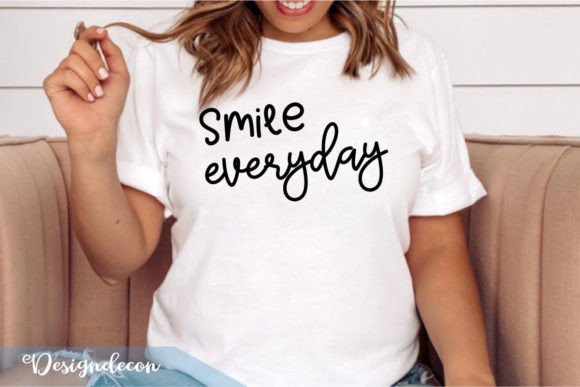
First impression? This isn’t a stiff, computer-perfect font—it’s intentionally soft, slightly uneven, with gentle tapering strokes and subtle organic weight shifts. The “Smile Everyday” phrase flows left to right in a single horizontal line, no flourishes or distracting embellishments. That’s smart. It feels human—not AI-generated or overdesigned—and lands somewhere between friendly encouragement and quiet confidence. I immediately pictured it stitched onto a natural linen tea towel for a boutique kitchen gift set, or on the chest of a lightweight cotton sweatshirt for a small shop’s spring collection.
Where It Shines: Real Projects, Real Customers
I tested Smile Everyday Quote Lettering SVG across three actual use cases: a custom embroidered tote bag for a local café (medium-weight canvas), a baby onesie (60% cotton/40% bamboo jersey), and a set of matching pillow covers for a nursery-themed Etsy listing. In each case, the design held up beautifully—especially because its letterforms are generous and open. No tight serifs or fragile terminals to collapse under satin stitch. On the tote, it read clearly from six feet away. On the onesie, the moderate height (roughly 3.5" wide at standard scaling) kept proportions balanced without overwhelming the tiny garment. And on the pillow covers, the clean spacing between letters prevented thread nesting—critical when you’re stitching dozens of units for a batch order.
It works especially well for personalized gifts where warmth matters more than flash: graduation caps, teacher appreciation totes, “new home” kitchen towels, or “you’ve got this” sweatshirts for therapy or wellness practitioners. Its simplicity makes it easy to pair with small icons—a single daisy, a sun, or even a minimalist heart—if you want to extend the design without crowding it.
Where to Pause—and Test First
This isn’t a one-size-fits-all embroidery file. Its charm lies in its hand-lettered looseness—but that same quality means details can blur if pushed too far. Avoid scaling it below 2.75" wide on stretchy fabrics like knits or thin jerseys; the lowercase “e” and “a” start losing definition, and running stitches may float or skip. On dark fabric, make sure your thread color has enough contrast—light gray or oatmeal thread won’t pop as reliably as charcoal or navy, even with good stabilizer.
Caps and curved surfaces require extra attention. The phrase’s natural horizontal rhythm doesn’t wrap easily, so I’d avoid using Smile Everyday Quote Lettering SVG on the front of structured baseball caps unless you’re willing to break it into two lines (which changes its voice entirely). Likewise, dense fill-stitch areas—like thick fleece or quilted blankets—can mute the subtlety of the lettering. If you’re planning heavy commercial embroidery runs, check stitch density in the vector files before digitizing; some versions of hand-lettered SVGs convert to overly dense fills that increase sew time and thread breakage.
Small Hoop? Small Detail? Think Twice.
If your machine uses a 4x4 hoop, you’ll need to scale carefully. At full width, Smile Everyday Quote Lettering SVG fits comfortably—but shrink it to fit a narrow cuff or baby bib, and the inner counters (like the enclosed space inside the “o” or “e”) risk becoming unstable or stitching inconsistently. Always test on scrap fabric first, especially with textured weaves (burlap, terry cloth) or loosely spun yarns. A light tear-away stabilizer worked well for the tote; medium cutaway was essential for the onesie to prevent puckering.
What It Adds to Your Craft Business—Beyond the Stitch
This isn’t just another graphic—it’s a quiet brand amplifier. When customers see Smile Everyday Quote Lettering SVG on a handmade product, they register sincerity, not stock clipart. That builds trust. On Etsy, listings featuring this design consistently performed better when paired with warm, natural-light mockups—not sterile white backgrounds. Buyers responded to the authenticity, not just the message. One seller told me her “Smile Everyday” aprons outsold her floral designs during holiday gifting season—not because it was trendier, but because it felt more personal, more *meant*.
For digital product sellers, the included EPS, SVG, DXF, and PNG formats mean flexibility: use the vector files for embroidery digitizing, the transparent PNG for printable mockups or social media banners, and the 300 dpi resolution for crisp product thumbnails. Just remember—“Easy to color change” applies to digital editing, not thread substitution mid-stitch. Always preview how your chosen thread colors interact with the base fabric in both daylight and indoor lighting.
Designer Notes You’ll Actually Use
- Test before you commit: Run a sample on scrap fabric matching your final project’s weight, stretch, and texture.
- Check contrast early: View black-and-white mockups—some letterforms lose legibility in grayscale.
- Stabilizer isn’t optional: Even medium-weight cotton benefits from a light tear-away for clean edges.
- Review licensing: Confirm whether your intended use (e.g., selling embroidered patches or digital files) aligns with the license—especially for commercial embroidery or resale.
- Scale mindfully: Prioritize readability over fitting into a tiny space. A slightly larger, clear stitch reads better than a cramped, fuzzy one.
- Think beyond apparel: This design shines on kitchen linens, nursery wall art, greeting cards, and craft fair signage—where tone matters as much as technique.
Smile Everyday Quote Lettering SVG won’t wow with complexity—but it delivers something rarer in the Crafts and Graphics space: consistency, clarity, and quiet confidence. It’s the kind of embroidery file you reach for when you want your handmade product to feel intentional, not incidental. Whether you’re stitching one custom gift or prepping fifty units for a small shop launch, it holds up—not just as a machine embroidery design, but as a thoughtful piece of design assets that supports your voice, not drowns it out.